Robot Overview
1. Product Introduction
The GR-3 is Fourier's first "Care-bot" humanoid robot designed specifically for interactive companionship, with "affinity," "safety," and "emotional interaction" at its core. Standing 165 cm tall and weighing 71 kg, the GR-3 features 55 degrees of freedom across its body, with a single-arm payload capacity of up to 3 kg, enabling more human-like body language and expression.
Through its soft color palette, flexible covering materials, and moderate height-to-proportion ratio, the GR-3 presents a relaxed and approachable overall image that visually softens its mechanical appearance and dispels the coldness traditionally associated with robots. The GR-3 is also equipped with Fourier's proprietary Full-Sense Interaction System, integrating three major modules—hearing, vision, and touch—to deliver more natural and human-like emotional interaction through coordinated feedback.
Every design aspect of the GR-3 is dedicated to creating a social companion capable of reading emotions and conveying goodwill, building warm human-robot emotional connections and intelligent collaboration through natural interaction in public service spaces.
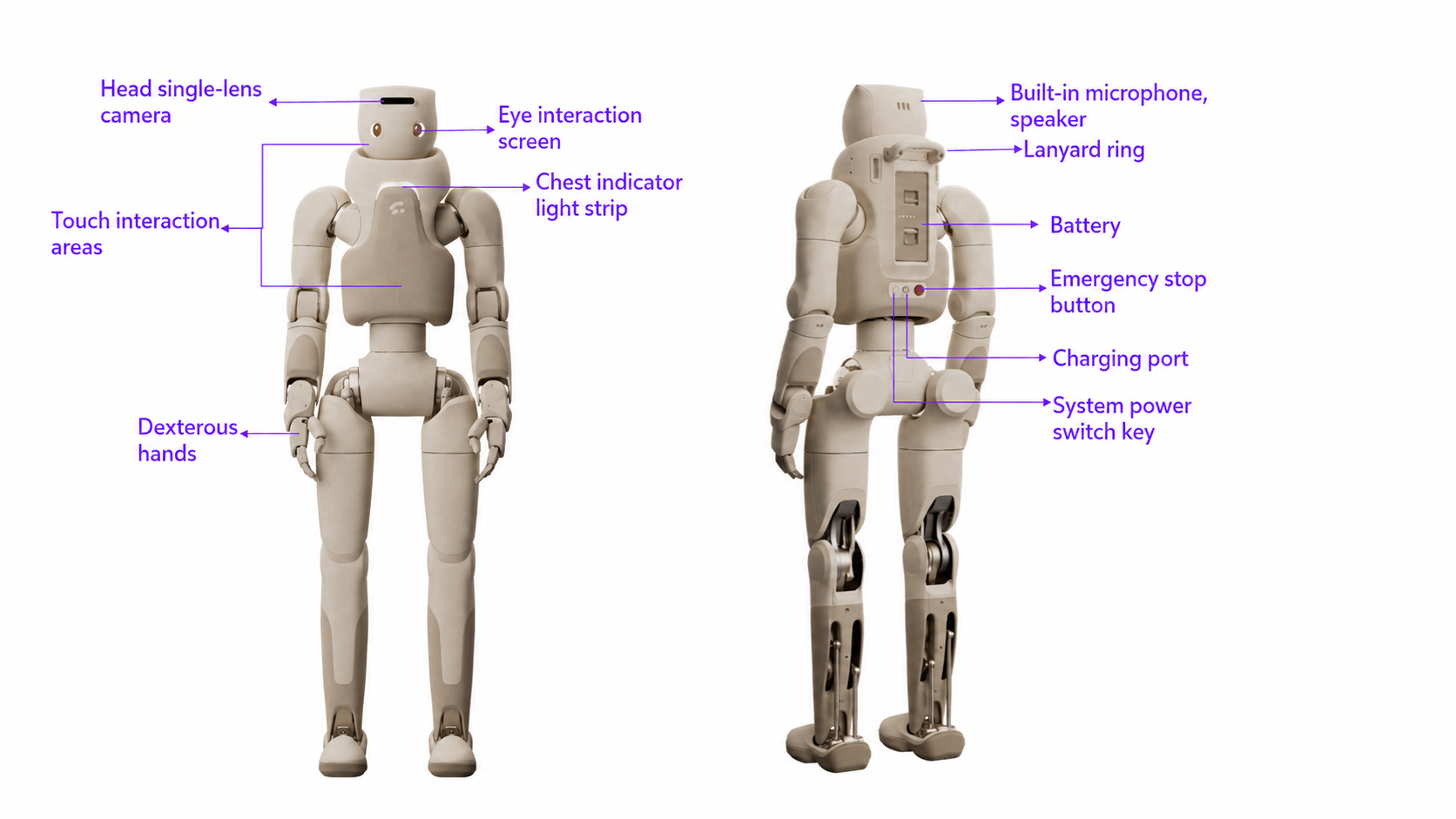
2. Component Illustration
3. Robot Specifications
| Parameter Category | Parameter Name | Details |
|---|---|---|
| Mechanical Parameters | Dimensions | 1642 mm × 552 mm × 292 mm |
| Arm Span | 1395 mm | |
| Arm Span + Self-Developed Dexterous Hand | Up to 1759 mm (12-DOF dexterous hand version) | |
| Lower Leg + Upper Leg Length | 425 mm + 408 mm | |
| Net Weight | ≈71 kg | |
| Materials | Aluminum alloy + Engineering plastic + Soft covering materials | |
| Electrical Parameters | Nominal Voltage | 46.8 V |
| Rated Power | ≈936 W | |
| Joint Parameters | Total Actuator Count | Up to 55 (with optional 12-DOF dexterous hand) |
| Maximum Joint Peak Torque | 440 N·m | |
| Head DOF | 2 | |
| Single Arm DOF | 7 | |
| Waist DOF | 3 | |
| Single Leg DOF | 6 | |
| Single Hand Base DOF | 6 | |
| Single Hand High DOF | Optional 12-DOF dexterous hand | |
| Dual Encoders | Supports absolute encoders | |
| Performance Parameters | Walking Speed | 6.1 km/h |
| Single Arm Payload | ≈3 kg | |
| Base Computing Power | 8-core 16-thread high-performance CPU | |
| Battery Parameters | Battery Type | Lithium-ion battery |
| Battery Capacity | 702 Wh + 234 Wh | |
| Total Weight | 3.8 kg + 1.3 kg | |
| Runtime | ≈3 h | |
| Single Charge Time | ≈1.5 h | |
| Battery Nominal Voltage | 46.8 V | |
| Charge Limit Voltage | 54.6 V | |
| Cycle Life | ≥ 500 (80% DOD) | |
| Hot-Swappable | Supports hot-swappable battery replacement | |
| Adapter Input Parameters | Input voltage range: 90 V AC ~ 260 V AC, 50 Hz / 60 Hz | |
| Adapter Output Parameters | Output voltage/current: 54.6 V, 12 A MAX | |
| Perception Sensor Configuration | Camera | Monocular camera |
| IMU | 6-axis, supports acceleration and angular velocity detection | |
| Microphone | 360° omnidirectional sound pickup | |
| Speaker | Up to 15 W, volume adjustable | |
| Tactile Sensors | Distributed on head and torso, supports tactile perception | |
| Interaction Capabilities | Teleoperation | Supports immersive remote control (VR headset / exoskeleton teleoperation) |
| Voice Interaction | Supports echo cancellation, sound source localization, voice interaction | |
| Central Processor | Operating System | Ubuntu 22.04 |
| CPU | AMD Ryzen 7 8845HS | |
| I/O | Type-C, USB3.0, RJ45 | |
| Communication | Wired Connection | Ethernet |
| Wireless Connection | Wi-Fi 6 | |
| Operating Environment | Operating Temperature | 0 to 45°C |
| Operating Humidity | 20% to 80%, non-condensing | |
| Terrain Adaptability | Max Obstacle Clearance Height | |
| Max Walking Gradient | 15° slope |
4. Development Board Specifications
| Parameter | Details |
|---|---|
| Processor | E-Sports D70 |
| CPU | AMD Ryzen™ 7 8845HS |
| GPU | AMD Radeon 780M |
| Cache | L3 16M |
| Memory | 32GB |
| Storage | 1TB |
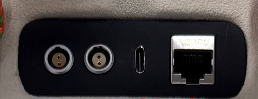
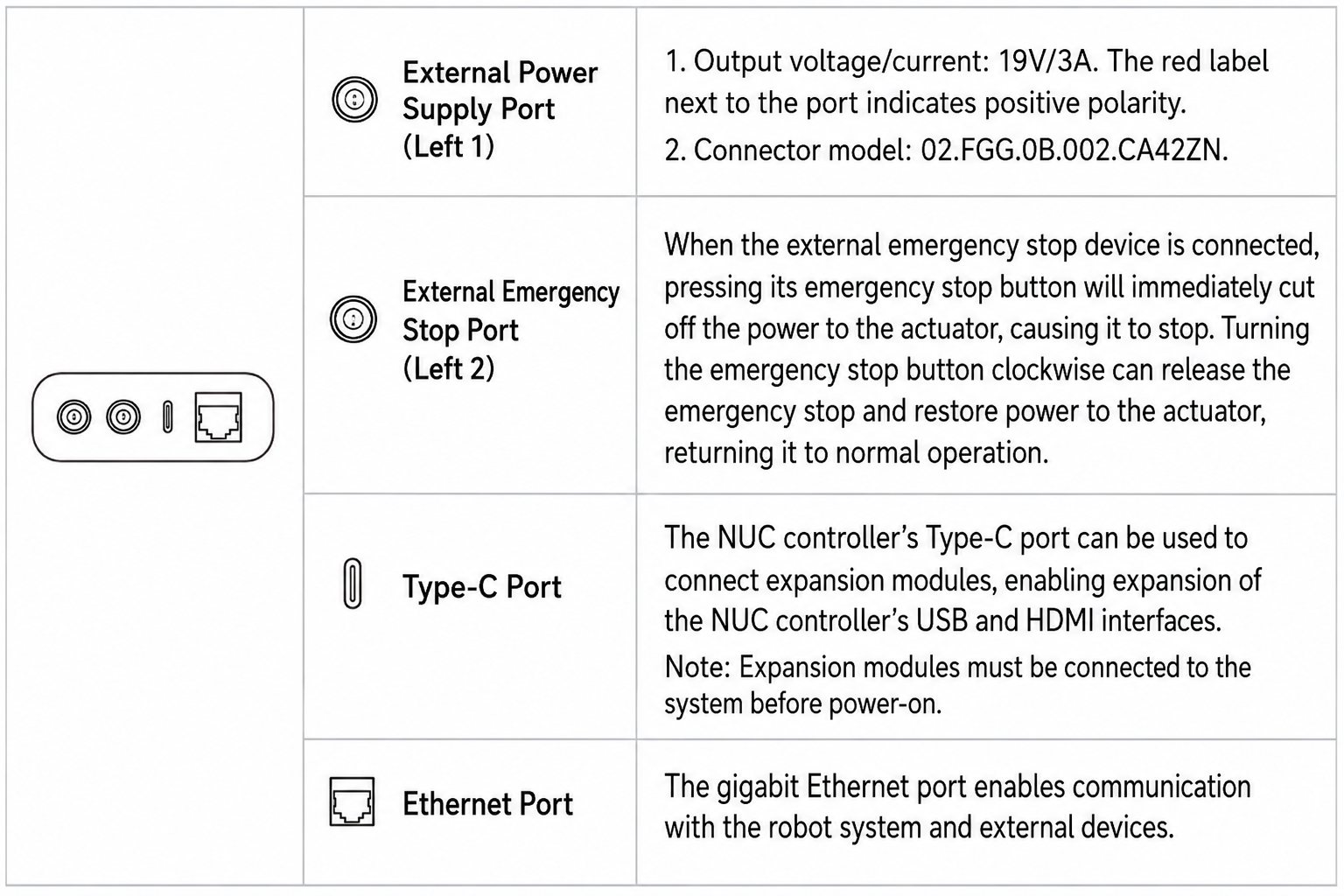
5. Body Interface Diagram
6. Joint Motion Range
6.1 Coordinate System, Joint Rotation Axes, and Joint Zero Position
The GR-3 joint rotation coordinate system uses the right-hand coordinate system, with axis color coding as shown in the figure below:
- X-axis: Red
- Y-axis: Green
- Z-axis: Blue
The figure also includes joint rotation axes and zero position information.
In the coordinate system, robot joint rotation can be categorized into three fundamental directions:
- Rotation about the X-axis: Roll
- Rotation about the Y-axis: Pitch
- Rotation about the Z-axis: Yaw
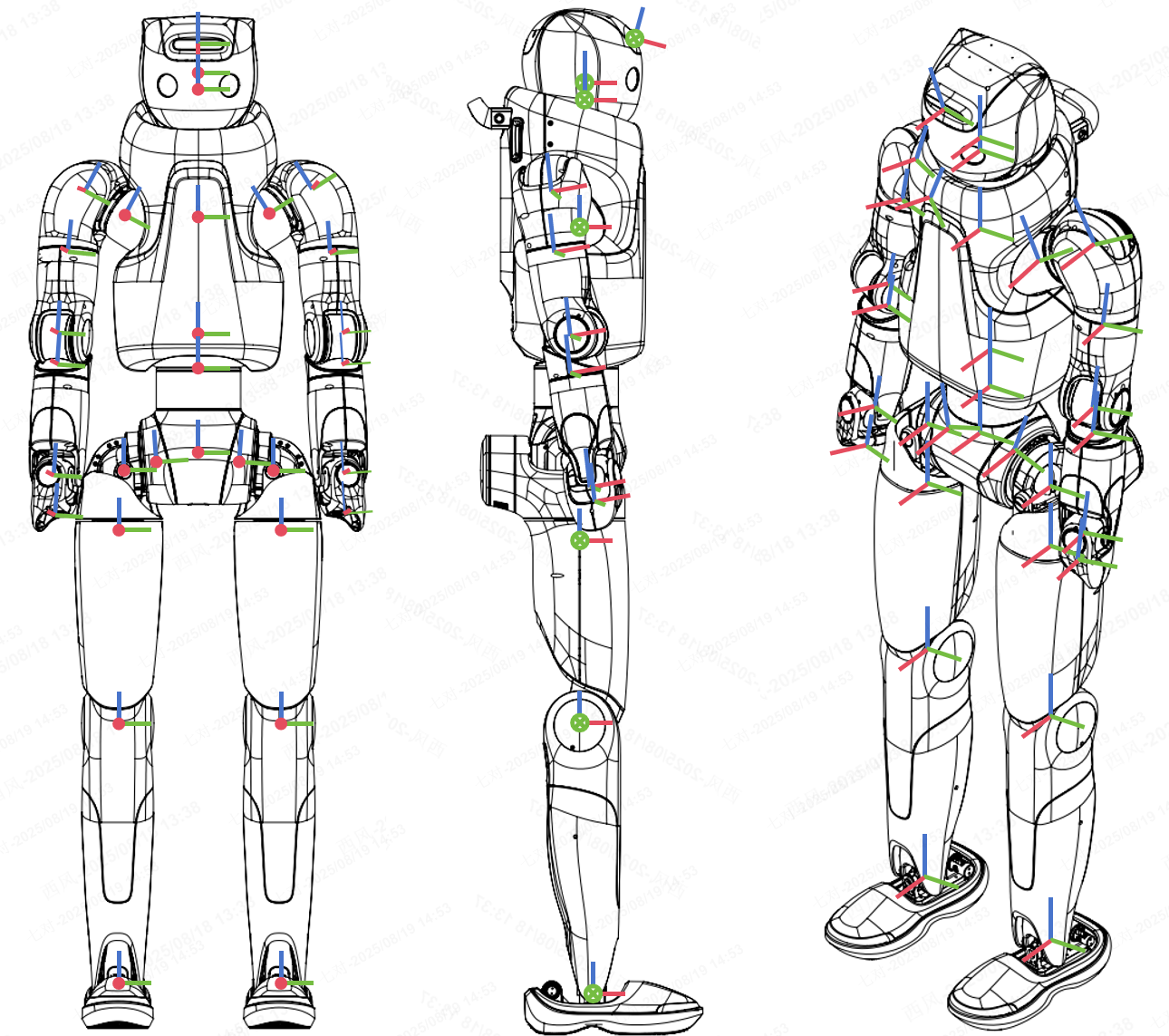
6.2 Joint Reference Diagram and Motion Limits
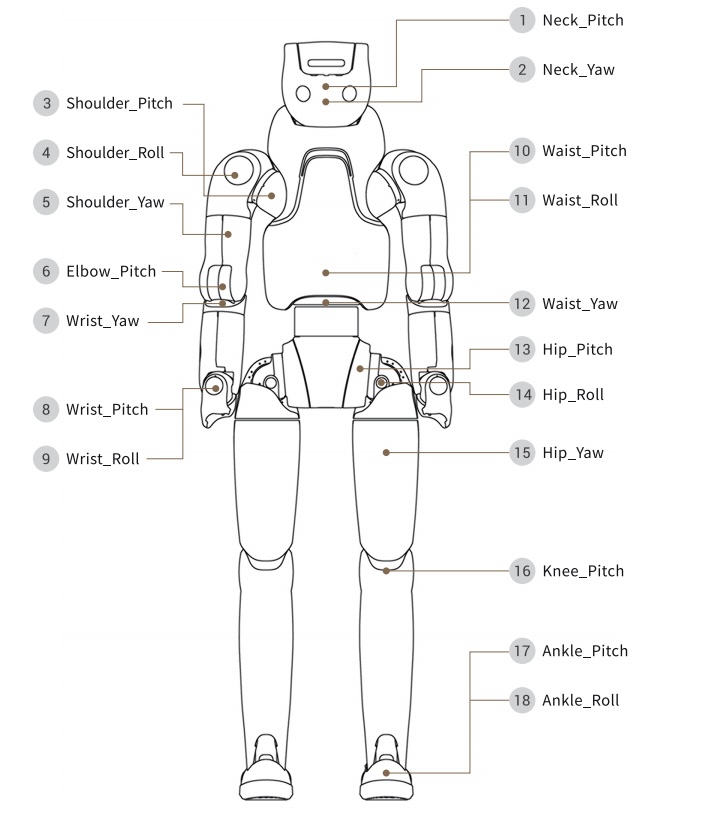
| No. | Joint Name | Motion Limits |
|---|---|---|
| 1 | Neck_Pitch | -30° ~ 8.5° |
| 2 | Neck_Yaw | ±80° |
| 3 | LeftArm_Shoulder_Pitch | ±170° |
| 4 | LeftArm_Shoulder_Roll | -15° ~ 110° |
| 5 | LeftArm_Shoulder_Yaw | ±105° |
| 6 | LeftArm_Elbow_Pitch | -130° ~ 5° |
| 7 | LeftArm_Wrist_Yaw | ±105° |
| 8 | LeftArm_Wrist_Pitch | -50° ~ 75° |
| 9 | LeftArm_Wrist_Roll | -60° ~ 70° |
| 10 | RightArm_Shoulder_Pitch | ±170° |
| 11 | RightArm_Shoulder_Roll | -110° ~ 15° |
| 12 | RightArm_Shoulder_Yaw | ±105° |
| 13 | RightArm_Elbow_Pitch | -130° ~ 5° |
| 14 | RightArm_Wrist_Yaw | ±105° |
| 15 | RightArm_Wrist_Pitch | -50° ~ 75° |
| 16 | RightArm_Wrist_Roll | -70° ~ 60° |
| 17 | Waist_Pitch | -12° ~ 30° |
| 18 | Waist_Roll | ±10° |
| 19 | Waist_Yaw | ±150° |
| 20 | LeftLeg_Hip_Pitch | ±150° |
| 21 | LeftLeg_Hip_Roll | -10° ~ 90° |
| 22 | LeftLeg_Hip_Yaw | -40° ~ 90° |
| 23 | LeftLeg_Knee_Pitch | 0° ~ 135° |
| 24 | LeftLeg_Ankle_Pitch | ±45° |
| 25 | LeftLeg_Ankle_Roll | ±25° |
| 26 | RightLeg_Hip_Pitch | ±150° |
| 27 | RightLeg_Hip_Roll | -90° ~ 10° |
| 28 | RightLeg_Hip_Yaw | -90° ~ 40° |
| 29 | RightLeg_Knee_Pitch | 0° ~ 135° |
| 30 | RightLeg_Ankle_Pitch | ±45° |
| 31 | RightLeg_Ankle_Roll | ±25° |
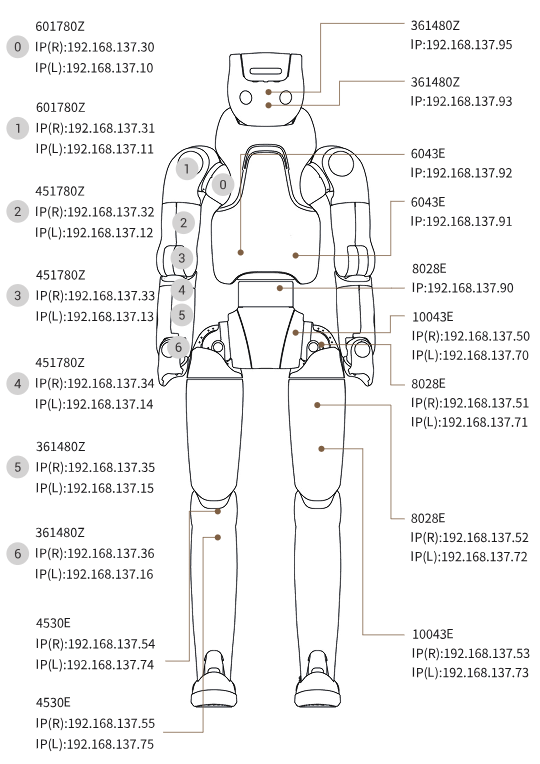
6.3 Actuator IP Address Diagram
7. Camera Field of View
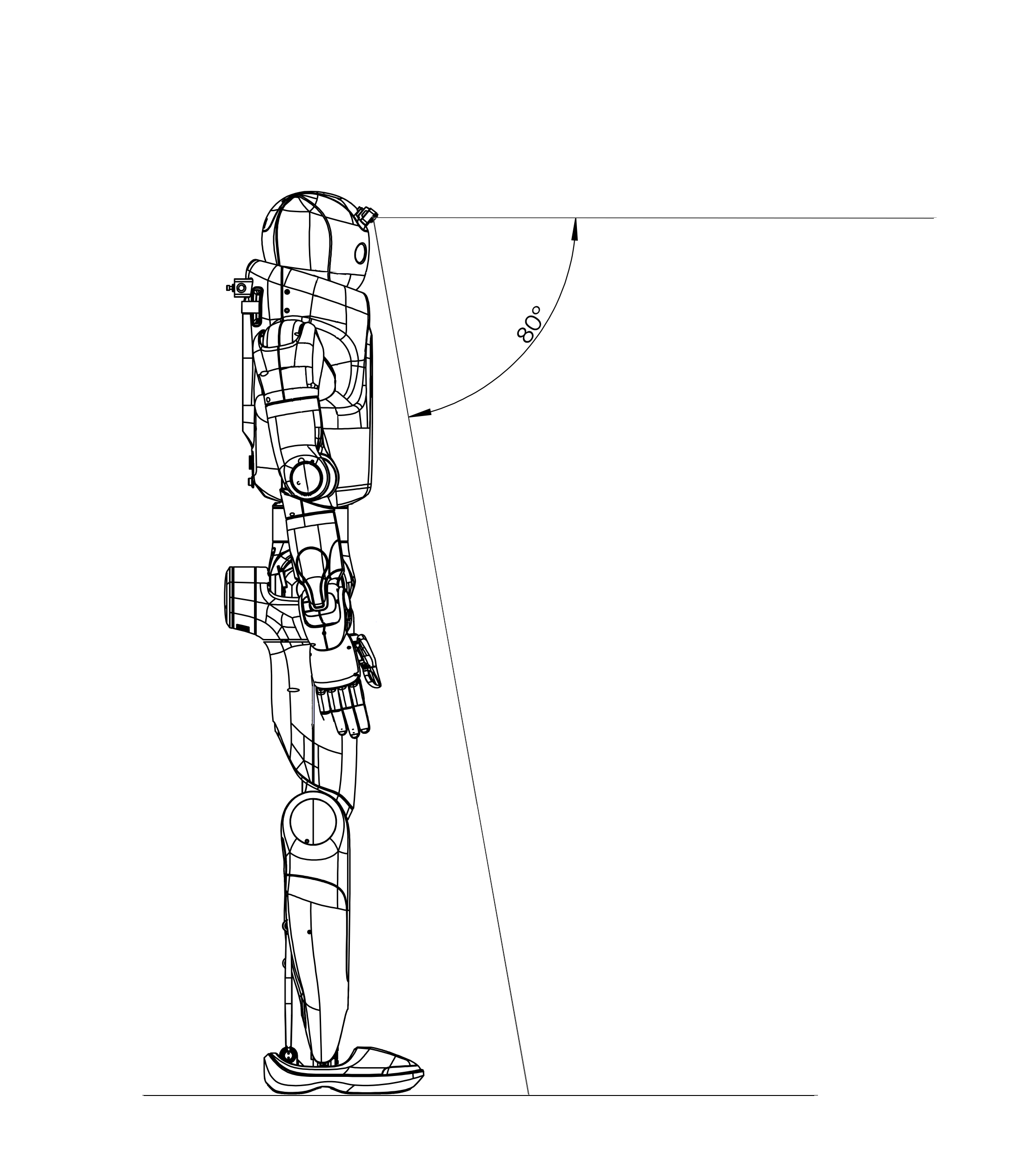 | 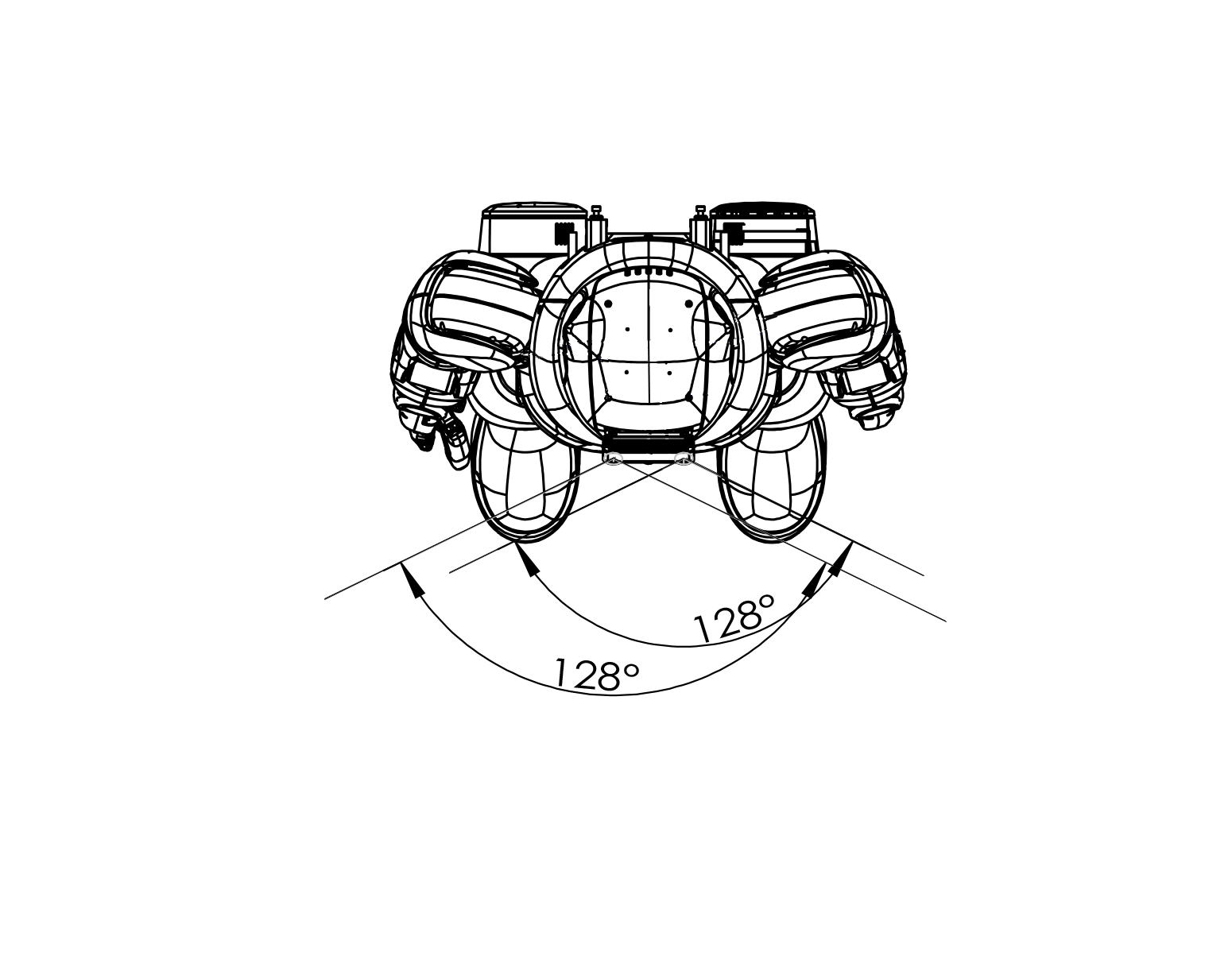 |
| OAK Camera - FOV - Vertical | OAK Camera - FOV - Horizontal |